Calate & Taktile
Calate calculators were manufactured by Advanced Telecommunications Equipment (ATE) which was based in Woking, England. The company launched the first Calate calculator at the end of 1972[1] and three models of calculators in October 1973[2] under the Calate name. However from early 1974 it changed over purely to OEM production for other companies.
Further information about the company is at the bottom of this page.
As well calculators under the Calate and Taktile names shown here, ATE also manufactured some models for Acme (Ajax) and Radofin under the Triton name.
Known models manufactured by ATE:
- Calate
- Supacal Calate / Semicomps Limited Calate
- Calate 8
- Taktile 1200
- Taktile 2001m
- Triton 8 - see under Radofin.
- Triton 1200 - see under Radofin.
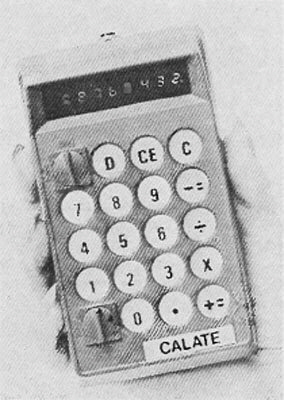
Calate
Power source - rechargeable batteries.
Display is 8 digits, red LED.
4-functions.
80 x 142 x 47 mm (3.1" x 5.6" x 1.8").
Has membrane keypad.
Under the photograph above, the journal "Electronics Today International" of October 1972 reported:[1]
"A new British designed and manufactured personal electronic calculator with 'touch plate' keyboard and recessed keys is claimed to have a larger display than any other pocket-sized calculator.
It is
both mains and rechargeable battery operated. The heavy duty Ni-Cd cells are claimed to improve reliability and minimise running costs and permit 500 complete discharges (an average of five hours work) before recharging is
required.
CALATE has an 8-digit display, a full floating decimal system and an automatic constant. It is capable of all four rules of arithmetic, both chain and constant multiplication and division, algebraic
logic and mixed sequential calculations. It weighs 8½ oz and measures 5½ x 3 x 1¾ inches."
The keyboard shown in the photograph above is slightly different to the Supacal model, below, which was said to be the first Calate model and it is not known if this version was actually marketed or whether it started with the Supacal.
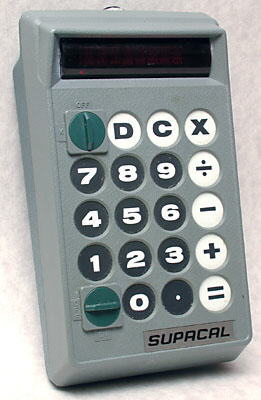
Supacal Calate
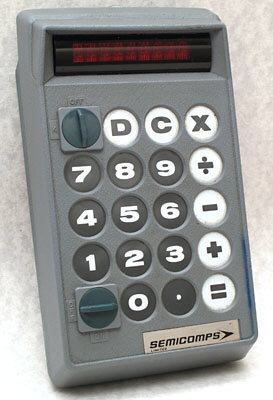
Semicomps Limited Calate
Supacal Calate / Semicomps Limited Calate
Power source - 2 AA rechargeable batteries.
Display is 8 digits, red LED.
4-functions.
80 x 142 x 47 mm (3.1" x 5.6" x 1.8").
Has membrane keypad.
Seen labelled Calate Supacal and Semicomps Limited Calate.
Manufactured by Advanced Telecommunications Equipment Ltd. (ATE), and marketed through Computer Ancillaries Limited and Semicomps Limited.
If you have any information about Computer Ancillaries Limited or Semicomps Limited please get in touch.
This was the first calculator model manufactured by ATE and is a rather chunky design with a couple of unusual features: the membrane keypad and the rotary switches.
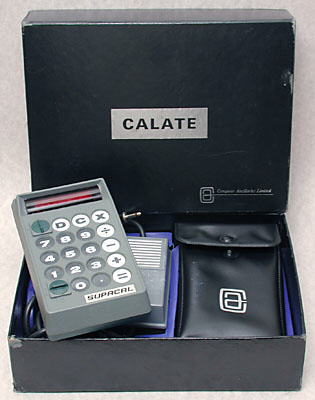
The complete calculator boxed set with soft PVC case and recharger.
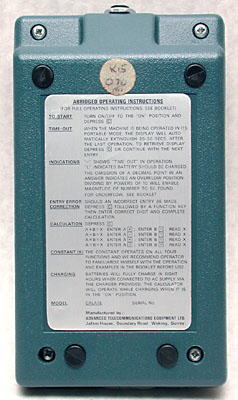
The rear of the calculator.
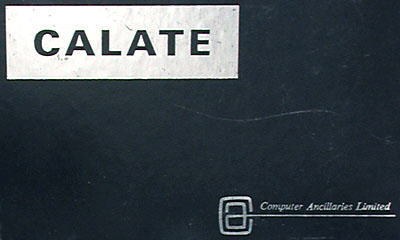

The calculator was sold under the Calate name (from Computer Ancillaries Limited), as seen on the box and pvc case. The relationship between Advanced Telecommunications Equipment Ltd. and Computer Ancillaries Limited is not known, but CAL was probably just the distributor.
Close up of the label showing the manufacturer.
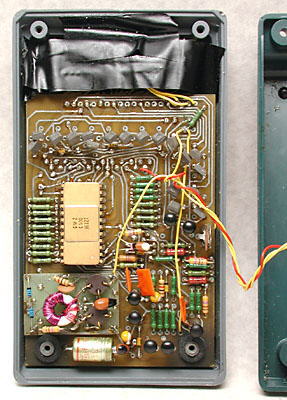
The calculator circuit board with the gold-coloured General Instrument Microelectronics C500 integrated circuit, very prominent. The LED display module is held in place with pvc tape, which may be a later addition.
There is information about the electronics in the Pocket Calculator Kit Review below.
The British magazine "Practical Electronics" of May 1973[3] contained a review of a self-build kit version of this calculator, from which the following is extracted:
POCKET CALCULATOR KIT REVIEW
Supacal Calculator
Obtainable from S.C.S. Components Ltd., P.O Box 26. Wembley, Middx HAO 1YY.
Price £39 (+ V.A.T.) with special £4 discount to P.E. readers.
Immediately upon opening the box containing the SUPACAL calculator kit the decision should be made as to whether one is sufficiently equipped in terms of both tools and experience to undertake the construction of the
calculator. Should there be any doubt in this respect, it is strongly recommended that the services of a more experienced friend or colleague be recruited for this work. The minimum tools required for building the
kit are a good soldering iron of 10 to 25 watts with a bit preferably no more than a sixteenth of an inch diameter, also a pair of side cutters, a pair of long nosed pliers, and a good light.
Many solder joints have
to be made in a small area and a certain degree of skill is needed to avoid short circuits and dry joints. Fine solder is provided with the kit and this greatly simplifies the construction.
COMPONENT PACKING
All components come in plastic bags marked with the value of the components contained, but it is as well to check these values against those required
as it is always better to be safe than sorry. Because the printed circuit board has tracks both sides many solder joints have to be made on both sides of the board; this is tedious but it is essential to make good
connections.
The display board and the inverter board for the 25V i.c. supply come as ready made units and this eases the constructor's task enormously. The keyboard is already fitted into the lop half of
the case and wiring to the main circuit board is simple, though here again solder joints have to be made top and bottom of the board.
HANDLING PRECAUTIONS
The calculator i.c. comes in a piece of protective conductive foam and the handling precautions in the instructions should be carefully
followed. A socket is provided for the i.c. so the usual problems of soldering to an m.o.s. integrated circuit are overcome.
Instructions for the insertion of all components are given and these are easy to
follow. A circuit diagram and point-to-point wiring diagram are also supplied. Total construction time for the SUPACAL was three and a half hours in this reviewer's case. Any difficulties will probably be
caused by poor soldering and a good light is useful for checking.
The kit suppliers offer a back-up service in the form of a fixed price repair facility and this ensures a fully working calculator no matter how much
of a mess you made of the construction. Once the calculator is working then all parts are guaranteed for one year.
CALCULATOR CONSTRUCTION
Now something about the calculator itself. It is housed in a strong plastics case and uses two rechargeable batteries for its power
source. A ready built charger is provided with the kit; fully charged batteries give about eight hours working. There is an automatic fade-out facility which switches off the display (which consumes about half the total
power) approximately ten seconds after a key has been pressed.
The keyboard uses conductive rubber contacts which give the machine an extremely light touch; in fact the switches are almost too sensitive, some care
being needed not to enter a digit unintentionally.
CAPABILITY
The calculator can handle all four arithmetic operations with all calculations being in floating point, with eight digits being displayed. There is a
stored constant facility which, unlike most other calculators, can be used with all four functions. Another advantage of the calculator is that it will not overflow. Other calculators will ignore any entries over eight digits
long; the SUPACAL stores not only the eight digits entered but also stores an exponent up to 1079; the true decimal point position is found by dividing by powers of ten until the
point appears on the display. This enables more accurate answers to be found.
INSIDE THE POCKET CALCULATOR
How does the pocket calculator work? The "heart" is the second generation single chip MOS LSI circuit type
C500 manufactured by General Instruments Microelectronics. It contains within its 4000 active devices all the logic necessary for performing eight-digit, four function plus constant and floating decimal point
calculations.
The chip contains a read-only-memory (ROM) of 2,000 bits, a random-access-memory (RAM) of 100 bits and associated control logic, dividers, and timing circuits for for clocking and multiplexing.
The chip simply requires a 25V supply and a clock input of 50 to 100kHz, a keyboard, display, and circuits to drive the display and it becomes a fully operational calculator.
The display interface is by means of
discrete buffer/driver transistors for segment and digit driving. The display is multiplexed, i.e. each digit is only driven for one-ninth of the time, there being nine l.e.d. digits with seven segment format.
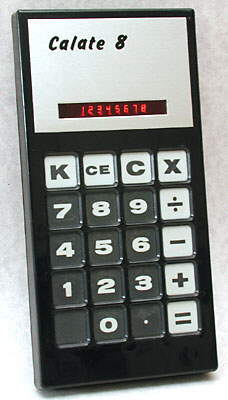
Calate 8
Power source - PP3 9v battery.
Display is 8 digits, red LED.
4-functions.
Integrated circuit - General Instruments GIMT C550. Although this has no visible date code, the other integrated circuit on the board is date coded week 43 of 1973.
78 x 156 x 24 mm (3.1" x 6.1" x 0.9").
About 1973.
This model, again with the unusual membrane keypad, was developed to be much slimmer than the Supacal above and so be more pocketable.
The back has been removed to reveal the circuit board with the GIMT C550 calculator ceramic cased integrated circuit.
Note the reduction in components on the circuit board compared with the Supacal above.
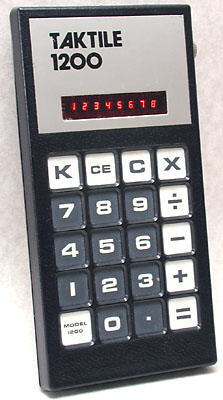
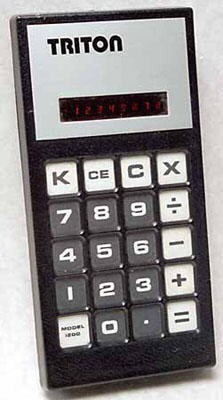
Taktile 1200 & Triton 1200
Display is 8 digits, red LED.
Four function.
Integrated circuit - General Instruments CZL-550, date coded early 1974 in both of the calculators pictured here.
9v (PP3 battery).
76 x 154 x 24 mm / 3.0" x 6.8" x 0.9".
Has membrane keyboard.
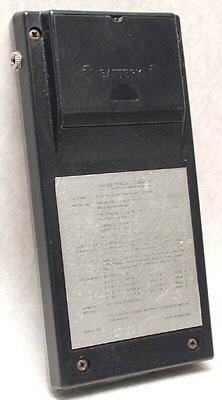
This is fairly thin calculator with a "pregnant" bulge to accomodate the 9v battery. Unlike some Sinclair models which had the same feature, the bulge here is at the top of the rear so the calculator sits on a desktop at a usful angle inclined to the user.
Taktile is a trade name used by ATE, derived from the tactile membrane keypad used.
Triton is a trade name of Radofin, an import-export company which ATE supplied with calculators. See the history of Advanced Telecommunications Equipment, below.
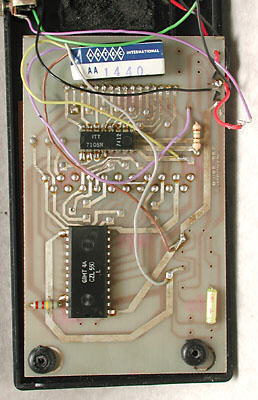
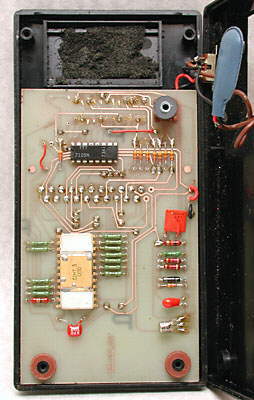
The circuit board with the General Instruments CZL-550 calculator integrated circuit, and a smaller display-driver IC.
Note that this board appears to be a development of the Calate 8, above since it has fewer components and a plastic encapsulated integrated circuit has replaced the more expensive ceramic packaged type.
Rear of the calculator showing the bulge to take the 9v battery.
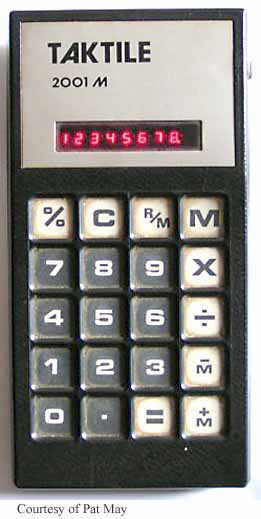
Taktile 2001m
Display is 8 digits, red LED.
Four functions, %, memory.
A similar design to the Taktile 1200, above, but with the more advanced features of memory and percentage key.
Information about Advanced Telecommunications Equipment
1) Report on electronic calculator markets and suppliers in the UK
A report on electronic calculator markets and suppliers in the UK published in 1973[4] contains the following information:
Advanced Telecommunications Equipment (ATE)
Jafam House, Boundary Way, Woking, Surrey.
Small independent UK manufacturer of telecommunications and other equipment which was producing and marketing its own Calate range of electronic calculators for about 18 months. Since the beginning of 1974 it has ceased marketing its own brand in order to concentrate on OEM production, for Acme Electric (Ajax), Triton and other brands. Trade enquiries are handled by Radofin.
The Calate range was widely available in non-traditional retail outlets, and although basically low priced (generally retailing at about £20) was soundly based technically, using General Instrument LSI chips. These features have been carried over to the Acme and Triton 1200 models but several up-market variants are due to be added shortly, including a machine with memory within three months. Production is scheduled to reach hundreds of thousands this year and in 1975 the company hopes to become the largest UK manufacturer, which we would not consider impossible if financing is adequate. The company makes its own tactile keyboard (non-moving) and is introducing its own moving key type.
Other production includes data communications terminals marketed via ITT Creed.
2) History of Advanced Telecommunications Equipment
Graham Jater who was involved in the development of Advanced Telecommunications Equipment has generously provided a copy of his book "Graham's Memories of Younger Years"[5]. The following is a summary from it concerning ATE and its calculators:
Advanced Telecommunications Equipment was a company founded by Stanley Reeves in 1972 to manufacture electronic controls. Graham Jater, Stanley's father-in-law, had just decided to take early retirement from Crater Controls Ltd., a highly successful company that he had co-founded in 1947.
On reviewing the market it was decided that producing the electronic controls as designed would not be viable, so Graham contacted semiconductor manufacturers and discovered the emerging hand-held calculator, which was based on the newly developed single integrated circuit ("calculator on a chip") and the LED (Light-emmitting Diode) display.
Graham and Stanley decided that producing hand-held calculators would be profitable and Graham decided to assist ATE on a part-time, non-salaried, advisory basis.
Stanley was in touch with Radofin, a London company involved in imports and exports in the plastics industry. Radofin had contacts in Singapore who could rapidly produce moulds for the plastic casings of calculators, and informed ATE that if the mouldings were part of a product that Radofin could export then the moulds would be supplied free of charge.
Graham set about designing the circuitry and keyboard of a calculator. For the latter he used his experience at Crater Controls and chose a membrane keypad since it required far fewer components than a conventional keypad. A local draughtsman designer produced drawings for the casing.
When shown the drawings Radofin reported that the moulds could be produced in Singapore and they thought that there were export opportunities for the proposed calculator.
While waiting for the moulds to arrive Graham found and financed the purchase of suitable premises for manufacture in Boundary Way, Woking. These were called "Jafam House", which denoted that they were a Jater family property.
They were very pleased with the resulting grey plastic mouldings that were delivered and how well the first completed calculators worked. They decided to use the trade name "Calate" for the calculators and this first model was the "Supacal". Radofin thought that they would sell well and so a quantity of sample calculators were assembled for them.
Although the circuits boards were bought in drilled ready for the components to be soldered on, which saved time, orders came in faster than expected. After several months ATE was producing 700 calculators a week, which covered costs, but was not meeting demand. However, the hand-held calculator market was evolving rapidly and the Supacal was soon considered to be too bulky; its size being dictated by the large number of electronic components required and the large batteries needed to power the electronics.
The semiconductor manufacturers could now provide calculator chips with more of the components integrated within, and with a lower power consumption so that a smaller battery could be used. Going through the design process a second time resulted in a much slimmer, lighter, and ergonomic design. ATE gave these models the trade name "Taktile", derived from the tactile membrane keypad which was again employed, whereas the trade name "Triton" was applied to the calculators marketed through Radofin. These models proved popular and with production increasing to 1500 calculators a week the resulting economies of scale allowed some of the cost reductions to lower the selling price, and also allowed an increase in profit margin for ATE.
Graham Jater was of the opinion that the company had a couple of years lead, till about 1977, before Asian manufacturers with their skills and lower labour costs would start to satisfy the world market with lower prices. He did not want to be in calculator manufacturing in the longer term, so did not cover the designs with patents or copyrights, and would leave to Stanley Reeves the direction and products of the company when he withdrew from it.
However, in 1976 Stanley informed Graham that the company had financial problems with a large amount of money owed to the bank. Having produced 86,000 calculators to date the order book was average. Graham consulted Radofin who told him that the eastern manufacturers were catching up with technology rapidly and they were expecting the market to be flooded with very cheap products. Due to this situation, Graham decided that he should obtain the best deal on the closing down of ATE. Following difficult negotiations with the bank over the repayment of the loan taken out to purchase Jafam House, during which further debts were revealed, an agreement was reached for a financial settlement. Sadly, this settlement entailed the Jaters having to sell their large house and move to somewhere smaller.
Thus Advanced Telecommunications Equipment ceased to exist.
© Graham Jater, 2008.
References:
- "Equipment News: Pocket Calculator", Electronics Today International, October 1972, p73.
- Owen, Kenneth, "American link expands range and techniques", The Times, 15 February, 1974.
- "Pocket Calculator Kit Review: Supacal Calculator", Practical Electronics, May 1973, p428.
- Milton, R., Beaumont, A.J. (1974), Electronic Calculator Markets and Suppliers, 2nd. ed., Finresearch Series, London: Ovum, p97.
- Jater, G. (2008), Graham's Memories of Younger Years, published by Graham Jater.
British calculators
Vintage Calculators
© Text & photographs copyright Nigel Tout 2000-2019 except where noted otherwise.