Muldivo Mentor
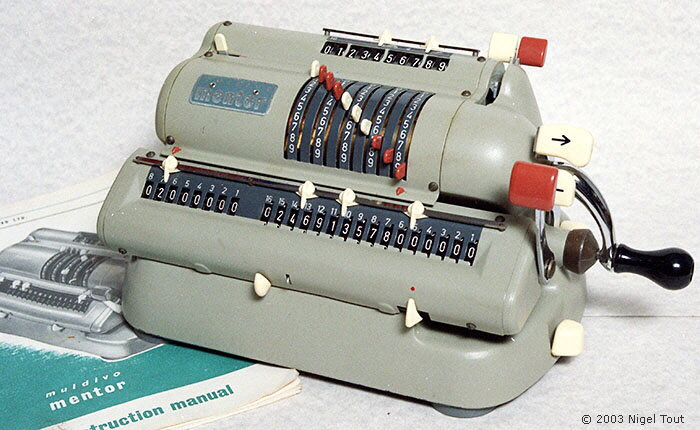
Muldivo Mentor / Walther WSR160
An Odhner-type rotary pin-wheel machine. This machine is fitted with a very useful back-transfer mechanism actuated by the small red lever at top right. This transfers the number in the result
register back up to the setting register so that it can be used in further calculations.
For details of the pinwheel mechanism click here.
285 mm x 155 mm x 136 mm (11.25" x 6.1" x 5.4").
Made in 1960s.
Made in Germany by Walther (model WSR 160).
In the 1960s this model was promoted for use by schools in teaching the basics of mathematics as described in Muldivo Calculators for Schools (pdf format).

Walther was the manufacturer and Muldivo was the British importer and distributor. See the carton of the Mentor above.
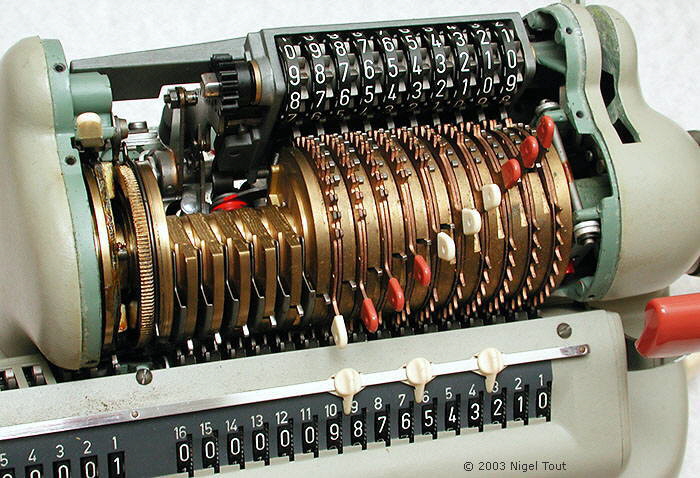
With the front cover removed showing the pinwheels set to 9876543210, so that the corresponding number of pins in each decade protrude.
The crank has been turned once to add the pinwheel settings to the accumulator register below.
Note that the pinwheel mechanism is of high quality, machined from brass. Cheaper calculators, such as the Nippon/Busicom HL-21, used die-cast pinwheels, which were prone to wear more quickly.
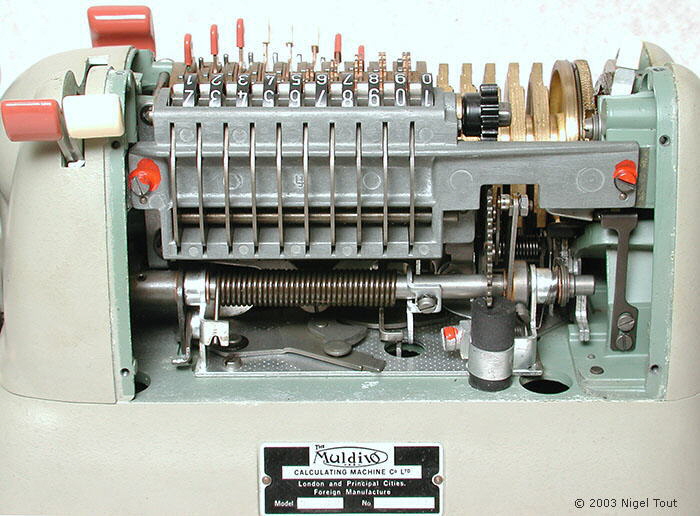
From the rear with the cover removed.
Improved Pinwheel Mechanism
Ray Girvan has pointed out that this machine has a significant improvement to the pinwheel setting mechanism, as shown in the photographs below, which he has kindly supplied:
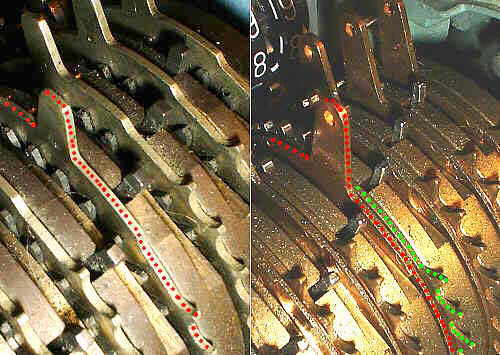
These photographs show the assembly of pinwheels, and their setting levers, of two different pinwheel calculators with the covers removed.
On the left is a Schubert machine, which has the normal pinwheel mechanism, with a setting lever indicated with red dots and the pinwheel disk to its right. When the crank is rotated, the setting levers rotate with the pinwheels through the slots, completely inside the machine, and back out again.
On the right is the improved mechanism of the Muldivo Mentor / Walther WSR160. The setting lever is again indicated with the red dots, and transmits through to the disk alongside, indicated with green dots, which actually sets the
pinwheel to its right. When the crank is rotated the disk marked in green rotates, but the setting lever and its red-marked disk stays still.
The main advantage is that each setting lever is topped with a soft plastic cap (see
photograph at top) which makes it easier to set the levers, and less painful on the fingers after hours of calculating!
Ray Mackay has produced an interesting history of the Walther Company and its calculators at http://www.xnumber.com/xnumber/walther.htm.
Operating Manual
Here is the Operating Manual of the Muldivo Mentor in pdf format.
Mechanical Calculators
Vintage Calculators
Text & photographs copyright, except where stated otherwise, © Nigel Tout 2000-2026.