Rockwell 920
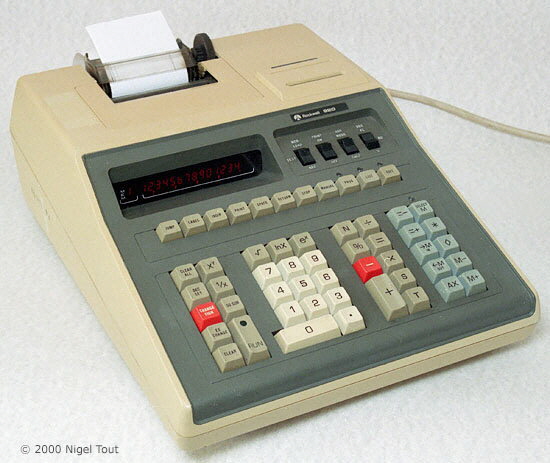
ROCKWELL 920
Distinctive features: Used an early 4-bit microprocessor, the Rockwell PPS-4 (Parallel Processing System). Is "designed to be easily programmable in a business office or scientific laboratory". Programs saved on magnetic cards.
Capabilities: 4 function, limited scientific, programmable, magnetic card reader.
- Basic machine has 9 memories and 192 program steps.
- Expanded machine model 920/2 has 41 memories and 448 program steps, cost £795 Sterling (about US$1850).
- Expanded machine model 920/3 has 96 memories and 996 program steps, cost £895 Sterling (about US$2080).
Designed to be easily programmable in a business office or scientific laboratory, with conditional jumps, symbolic addressing, memory indirect addressing, subroutine nesting to 4 levels, and simple debugging and editing.
Each
magnetic card can store 256 program steps on each side, and can also be used for storing data. Rockwell had an extensive library of programs available on magnetic cards that they could supply.
Display: 14 digits, amber gas discharge and printer.
Technolgy: Uses a very early microprocessor system[1], the 4-bit Rockwell PPS-4[2], based on the 10660 cpu. The Large Scale Integration (LSI) ICs are here date coded from 1974 to mid 1975, and comprise the Rockwell[3]:
- 1K byte Read-Only Memory (ROM, 1024x8-bit) - A0577PA, A0578PB, A0579PB, A0580PB, A0581PA
- General Purpose I/O - 10696PA
- Random-Access Memory (RAM, 256x4-bit) - 4x 10432PD, 3x 10432PC
- Central Processing Unit (CPU) - 10660PD
Size: 297 mm x 425 mm x 155 mm (12" x 17" x 6.25"), 8.25 Kg (18.25 lbs).
Rockwell International
Business Equipment Division/Sunnyvale California.
Assembled in Mexico, US, and Foreign Parts.
[Distributed in the UK. by Sumlock Anita Ltd.]
Significance: Uses the early Rockwell PPS-4 microprocessor, with printer and magnetic-card reader. This results in a large calculator with a lot of integrated circuits, which were required at this time for the memories, the card reader, and the printer.
The Rockwell PPS-4 system was also used in industrial and consumer products such as electronic toys and games[4].
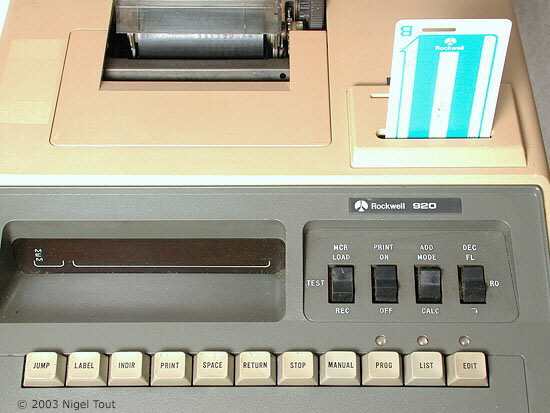
Rockwell 920 with a magnetic card about to be read.
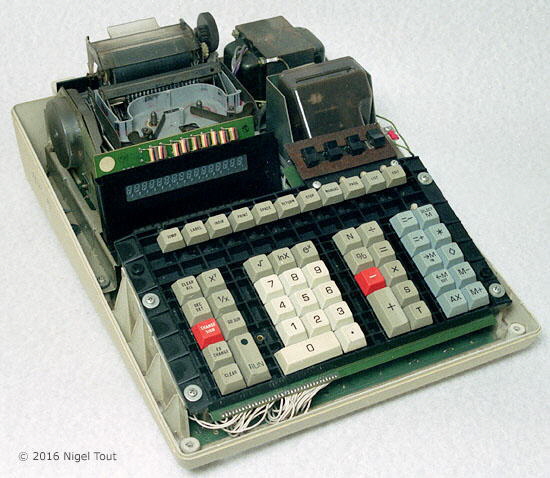
Rockwell 920 with cover removed.
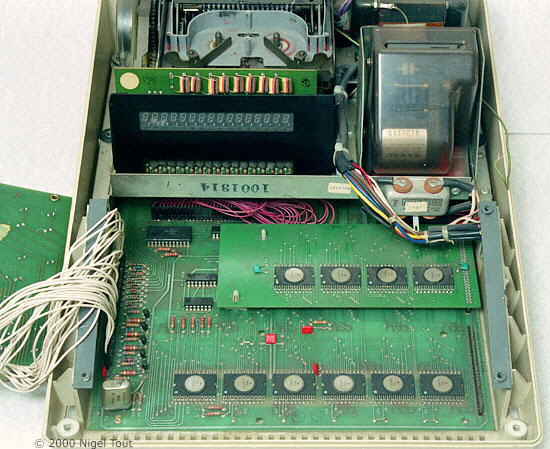
With the cover and keyboard removed, showing most of the integrated circuits of the Rockwell PPS-4 microprocessor system. The display is at top left, and the magnetic card reader is at top right.
The journal 'Electronic Design' announced the Rockwell PPS-4 microprocessor system in March 1973[1]:
"Four-bit microprocessor cycles instructions in 5 μs
What the calculator chip has done for the small hand-held electronic calculator the single-chip, central-processing unit
(CPU) is about to do for the more sophisticated calculator, point-of-sale terminal, computer terminal, automated test and measurement systems and industrial control systems. And as new manufacturers enter the marketplace, CPU
chips and their supporting circuits are becoming progressively cheaper and more powerful.
The newest, fastest and most sophisticated of the 4-bit CPU chips is the Model 10660 from Rockwell
Microelectronics. It has a 5-μs instruction cycle time and a 2.5-μs register to register add time. In 1000 quantities, it sells for
$22. It is normally sold as part of a set with at least one RAM, one ROM, one interface chip (I/O) and one multiphase clock generator. Together the chips form a bus-organized microprogrammed parallel-processing
system. The RAMs and ROMs are timeshared by the CPU. As a result, the CPU can handle up to 16 ROMs, each organized as 256 x 4 bits. The 1000-quantity prices for the ROM and RAM chips are $22 and $17,
respectively.
Each I/O chip can interface up to 12 I/O data lines with the microprocessor. Up to 16 I/O chips can be used with each CPU, thus yielding a total of 192 possible inputs and 192 possible
outputs. The 1000-quantity price of the I/O chip is $12.
A 200-kHz clock is necessary to make the microprocessor work. This is available for $7 in 1000 quantities, and it comes in a 10-lead TO-100
can. All other chips are in 42-lead, plastic dual-inline packages.
Another IC in the new series is useful for smaller applications. This is a ROM/RAM chip containing a 5632-bit ROM and a 304-bit
RAM. The price is $22 in 1000 quantities.
All of the parts are fabricated with standard p-channel, metal-gate technology, and they work from 0 to 70 C.
Only one power supply
(-17v)is needed. The CPU responds to a basic set of 50 instructions.
Subroutine nesting uses RAM storage instead of a push-down stack register. As a result a large numer of nesting levels are
possible, limited only by the available RAM storage. Microprocessors using a push-down stack usually allow only 3 or 4 levels of nesting.
Two 8-digit numbers can be added in 240 μs. Two 8-digit
numbers can be multiplied in 16 ms."
See also the Busicom 141-PF which uses the early Intel 4004 microprocessor.
Further information about Rockwell can be found in the Calculator Companies section.
References:
- "Four-bit microprocessor cycles instructions in 5 μs", Electronic Design, March 1, 1973, p94.
- "Rockwell PPS-4", 'AntiqueTech' website.
- "Data Sheet - Parallel Processing System (PPS-4) Microcomputer", Microelectronic Device Division, Rockwell International Corporation, 1973, p2.
- "PPS-4 - Rockwell International", 'WickiChip' website.
Electronic Desk
Calculators
Vintage Calculators
Text & photographs copyright, except where stated otherwise, © Nigel Tout 2000-2026.