Sharp QT-8D "micro Compet"
and clones
The Sharp QT-8D "micro Compet" was the first calculator using MOS LSI (Metal Oxide Semiconductor, Large Scale Integration) integrated circuits, requiring only four of them for the calculator functionality. It was also the first calculator to use a vacuum fluorescent display (VFD) and was the smallest electronic calculator at the time.
Sharp also produced clones of the QT-8D with slightly different casing styles for marketing by other companies:
- Sharp QT-8D "micro Compet"
- Addo-X 9354J
- Burroughs C3155
- Burroughs C3260 - has memory and performs calculations to 16-digits.
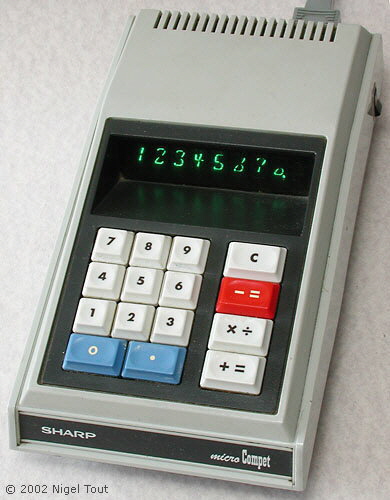
Sharp QT-8D with stylised "Itron" vacuum fluorescent display, with half-height zero, showing 12345670.
Sharp QT-8D "micro Compet"
Distinctive features: The first calculator to use MOS LSI (Metal Oxide Semiconductor, Large Scale Integration) integrated circuits.
The first calculator to use a vacuum fluorescent display (VFD).
Was the smallest electronic calculator at the time.
Technical details:
Display is 8 digits, newly developed green VFD (Vacuum Fluorescent Display) "Itron" tubes.
4 functions.
Semiconductors:
uses five MOS LSI integrated circuits manufactured by the Autonetics division of Rockwell.
"Has four MOS/LSI chips and a clock generator. Each chip contains 900 MOS transistor equivalents."[1].
"The logic tasks are split up among the four packages. The first, called the NRD 2256, handles the display and numerical read-in functions. Decimal-point control is taken care
of by the second circuit, the DC 2266. The third, AU 2276, handles digital addition and register input control. The fourth the AC 2266, rides herd on the arithmetic and provides the registers."[2].
See below for further information on the development of this model.
245 x 132 x 70 mm. (9.6" x 5.2" x 2.75").
Introduced October 1969.
Made in Japan.
Price, in September 1970 US$395[3].
By replacing the power supply circuitry of the QT-8D with rechargeable cells Sharp produced the QT-8B, one of the first battery-powered electronic calculators.
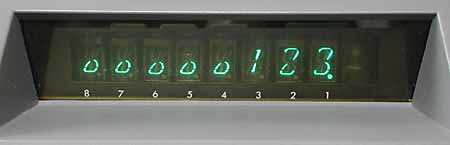
The newly developed Itron VFD display tubes here displaying '123'. The calculator electronics do not implement leading-zero suppression and the half-height zeros make the display more easily readable.
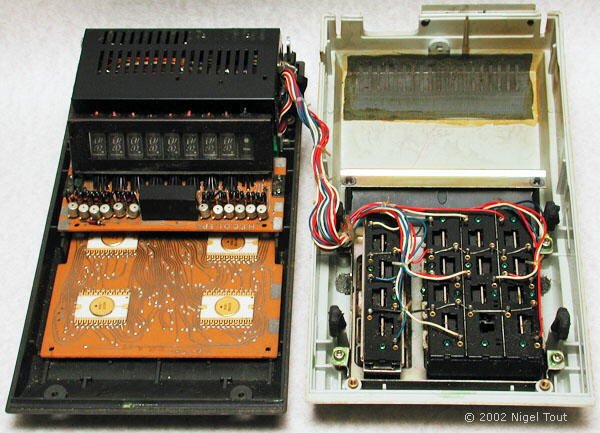
The calculator opened. On the left are the display board and the calculating board, which both plug into a two-slot socket.
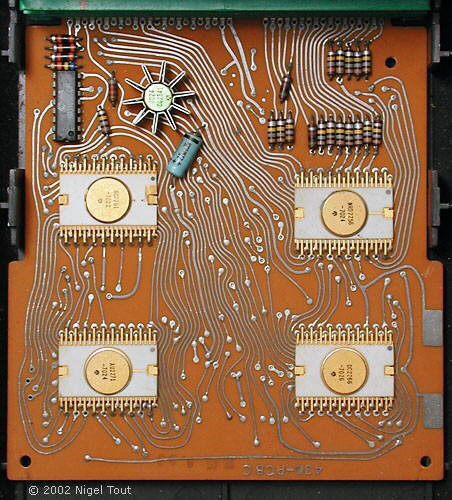
Here the display board has been unplugged to reveal the whole of the calculating board with the four Rockwell Large-Scale Integration (LSI) integrated circuits. The clock-generator integrated circuit has a star-shaped heat-sink clipped on.
The development of the Sharp QT-8D
Sharp Corporation has kindly provided information upon which the following is based:
By mid 1960's US manufacturers had opened a new page in semiconductor technology, i.e. LSI (Large-Scale Integration) ICs based on MOS (Metal-Oxide Semiconductor) technology. This made it possible to integrate thousands of
transistors on a single chip.
Although the U.S. semiconductor manufacturer Texas Instruments (TI) first demonstrated a prototype electronic calculator, called the "Cal-Tech", using this
technology in late 1966, the company was not ready to move into the consumer electronics market, remaining a component manufacturer.
Besides TI, there were several LSI manufacturers, such as Motorola, AMI, Fairchild
Semiconductor, RCA, National Semiconductor, and Rockwell (North American Rockwell), to which Dr. Tadashi Sasaki of Sharp attempted to offer the collaboration on developing a LSI calculator. However, it was only Rockwell's
Autonetics Division that accepted the offer of Dr. Sasaki, and a business agreement between these two companies was soon reached.
A team of system design engineers, headed by Yukihiro Yoshida, was sent to Rockwell where, with the support of Rockwell's design capability, they set about implementing the required set of MOS-LSI circuits by using the four-phase MOS dynamic logic which was originally developed by Rockwell. After a few years of hard work the design team succeeded in developing a LSI calculator, the Sharp Compet QT-8D, based on just four MOS-LSI chips produced by Rockwell. This was manufactured in the Nara factory, in Japan, and put on the market in August of 1969. This time there was a drastic reduction in price to 98,000 yen (US$270), weight to 1.4Kg ( pounds), and power consumption to 4W (using 4 MOS-LSI's and an 8-digit display using VFD tubes).
For further information about Sharp Corporation and its calculators visit the Calculator Companies section of this site.
The U.S. electronics industry was sceptical of the ability of the Autonetics division of the North American Rockwell Corp. to supply the MOS LSI integrated circuits for the Sharp QT-8D calculator. The journal Electronics reported in April 1969[4]:
'Ever since word leaked out that the Autonetics division of the North American Rockwell Corp. had been picked by Japan's Hayakawa
Electric Co. [renamed Sharp Corporation in 1970] to supply large-scale integrated MOS arrays for a 3-pound calculator, the U.S. electronics industry has been buzzing with wonder—and skepticism.
Typical is the reaction of a source at another company working hard on MOS products: "We feel Autonetics has a long row to hoe. Without faulting their technical ability, the Hayakawa contract calls for high-volume production with low unit prices. Not many in the industry have done this in MOS, and Autonetics doesn't have a history of being a high-volume, low-cost producer. Hayakawa will be pushing to get prices down, and we're not convinced Autonetics can do it."
...
The rewards, if all goes well for Autonetics in this venture, should be substantial. A source close to the situation estimates that the initial order could lead to additional business worth about $80 million over the next few years from Hayakawa alone. Autonetics officials decline to assign a dollar value to such prospects, but Eyestone [S.
Fred Eyestone, president of Autonetics] observes: "It's reasonable to say that we've talked with Hayakawa about supplying MOS to products beyond the QT-8D calculator.
..."'
'Discussions leading to Autonetics' contract to deliver more than 2 million MOS LSI arrays, of five different types, for Hayakawa's QT-8D calculator began some 10 months ago. Worth $30 million, the award
specifies that shipments begin in May and reach a peak of 160,000 units a month; it covers Autonetics work until January 1971. Thereafter, Hayakawa will produce the circuits itself in Japan under the terms of a
technical-assistance agreement.
One circuit interfaces between the calculator's functional MOS electronics and its input-output electronics. A second generates the logic functions for the calculator's
automatic floating-point feature, while another performs the basic binary-coded-decimal functions, generating most of the control signals for the three other logic circuits. A fourth generates the macromode control signals
associated with the calculator's functional keys. All are housed in Autonetics' new 42-lead package. The fifth circuit, packaged in a metal can, generates the multi-phase clock signals required by the four logic
circuits.
...'
However, Autonetics did have problems at first in producing the MOS LSI chips. The journal Electronics reported in September 1969[5]:
'Autonetics is finally delivering MOS LSI circuits for Hayakawa's desk calculators after the Japanese company flatly rejected all circuits produced by the American firm during July and August. The reason:
high rejection percentage among tested arrays made Hayakawa leery of using any. Autonetics considers the $30 million order its entree into the commercial LSI business.
But shipments are now rolling in,
says Hayakawa, adding that an engineer sent to Autonetics to supervise acceptance testing returned to Japan with a big batch of circuits. The problem apparently was created in going from 1.5-inch to 2-inch
wafers—diffusion conditionsevidently had to be changed. Hayakawa emphasises that it's confident Autonetics has everything under control.
The bad summer deliveries, nevertheless, forced Hayakawa to
delay introduction of its miniature calculator from August to October. In November, the firm says, it will receive 22,000 sets of circuits—80,000 arrays [chips]. The expectation is that Autonetics will have
made up the deficit by December, and that Hyakawa will be turning out 30,000 of the machines monthly by March.'
Apparently, the Autonetics division of Rockwell was eventually very successful in supplying the chips for the Sharp QT-8D, the hand-held Sharp QT-8B, and following calculators. Rockwell went on to be a major supplier of chips for calculators, and also manufactured and marketed its own calculators until the mid-1970s when it decided to exit the consumer electronics market.
The Sharp QT-8D also saw one of the first uses of a VFD (Vacuum Fluorescent Display) pioneered by Sharp[6], which is a lower voltage, lower power consumption alternative to the then common "Nixie"-type cold cathode tube. The VFD uses multiple anodes with fluorescent coatings. A further reason for the development of the VFD in Japan was the high royalty demanded by Burroughs on each of its "Nixie" tubes sold there[7].
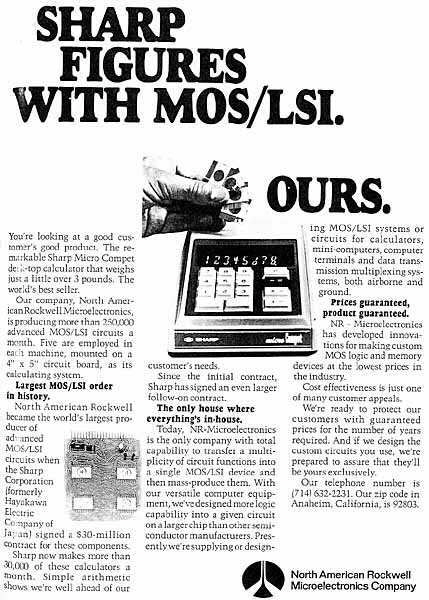
Advertisement for the Rockwell chip set used in the Sharp QT-8D, from September 1970.
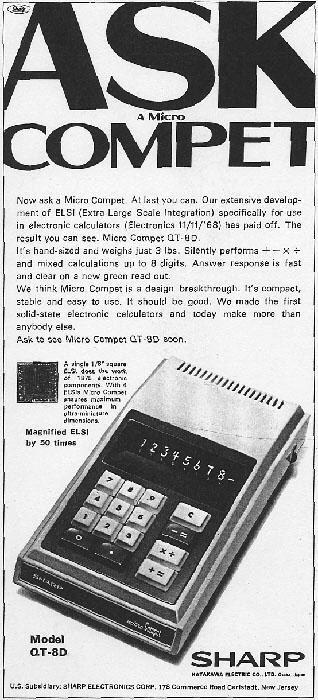
Advertisement for the Sharp QT-8D from October 1969.
Most of the contemporary calculators using MSI integrated circuits had fixed decimal points and so required more digits in the display to make them practical for many applications. For example the Sharp Compet 22 has 14 display tubes. The use of a floating point in the Sharp QT-8D allowed the display to be limited to 8 digits, which provided a drastic reduction in the width of the calculator.
The small size and reduced power consumption of the QT-8D further allowed the development of a hand-holdable version using batteries, the QT-8B—one of the the first purely battery-powered electronic calculators.
Sharp were pioneers in the field of calculator electronics starting with the CS-10A, one of the first transistorised electronic calculators in 1964. There is more information about the company and its innovative calculators in the Companies section of this site.
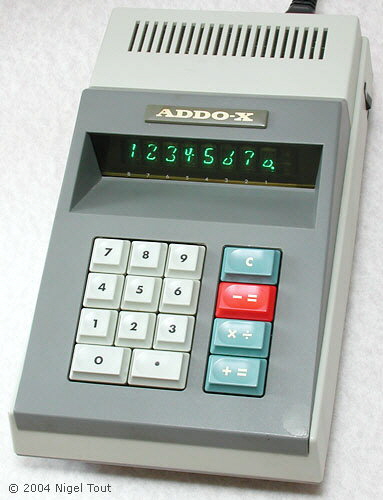
Addo-X 9354J
Main integrated circuits: Rockwell NRD2256, AC2261, DC2266, AU2271, here date-coded mid-1970.
This is a version of the Sharp QT-8D produced for sale by Addo, which had been a well known manufacturer of mechanical calculators and by then was owned by Electrolux of Sweden.
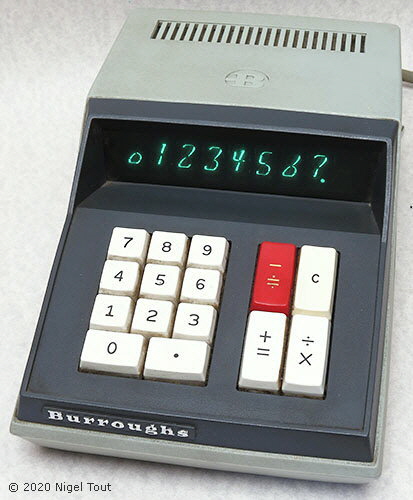
The calculator here is displaying '1234567'. The calculator electronics do not implement leading-zero suppression so the half-height zero makes the display easier to read.
Burroughs C3155
Main integrated circuits: Rockwell NRD2256, AC2261, DC2266, AU2271, here date-coded mid-1970.
This is a version of the Sharp QT-8D produced for sale by Burroughs of the U.S.A., which had been a well known manufacturer of mechanical calculators.
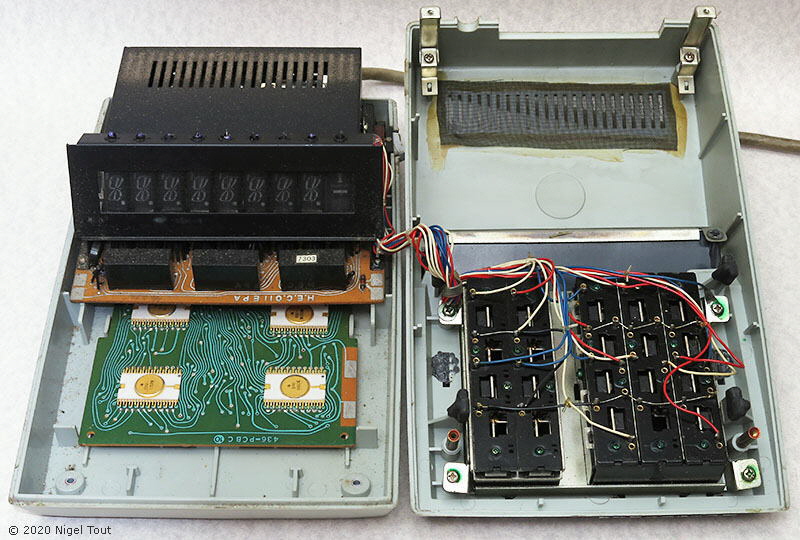
The calculator opened to reveal the main circuit board with the Rockwell integrated circuits.
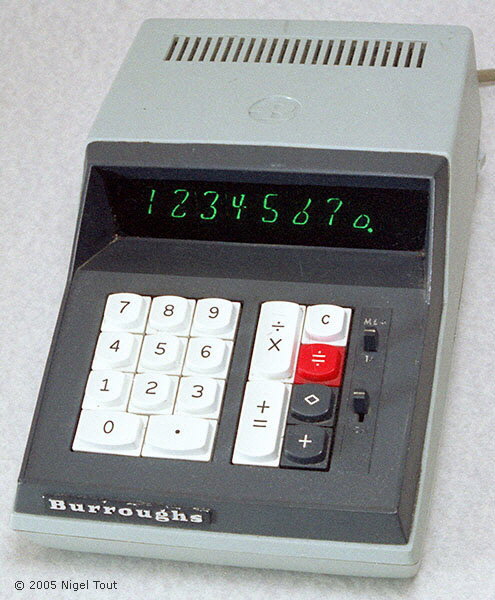
Burroughs C3260
An enhanced version of the Sharp QT-8D with the additional features of a memory and calculations which are performed to 16 digits with the capability of displaying the least significant 8 digits. Produced for sale by Burroughs of the U.S.A.
Integrated circuits: Rockwell CG1121, DC1152, ACM1156 NRD2256, AU2271C, and Hitachi HD3113P, here date coded early 1971.
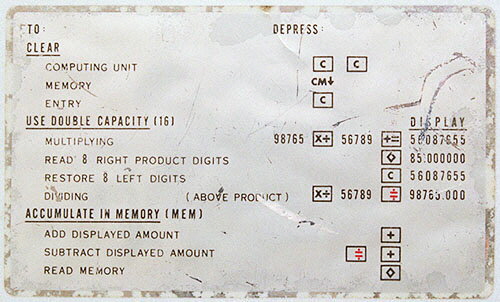
The operating instructions on the underside of the calculator.
At this stage in the development of electronic calculators the use of some of the keys is a little anachronistic to us now. See especially multiplying and dividing.
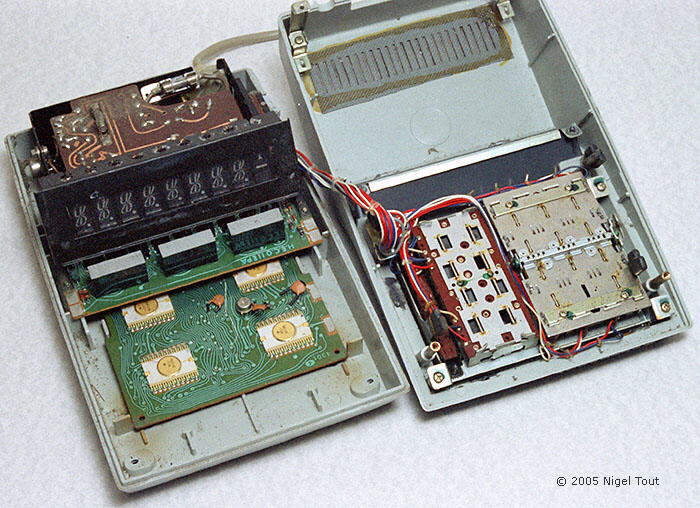
The Burroughs C3260 with the casing opened.
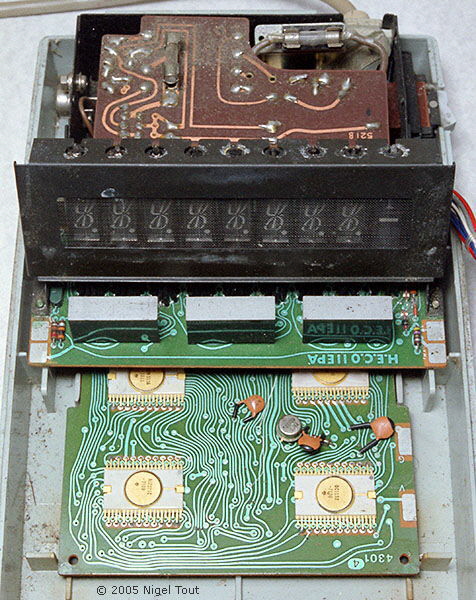
The main circuit board with the four main Rockwell integrated circuits. Note that the display board is marked H.E.C.O. which may stand for Hayakwa Electric Industry Company, the name of the company before it was changed to Sharp Corporation in 1970.
The following photographs show how the calculators produced by Sharp shrank with the integration of more of the electronics into integrated circuits over four years:
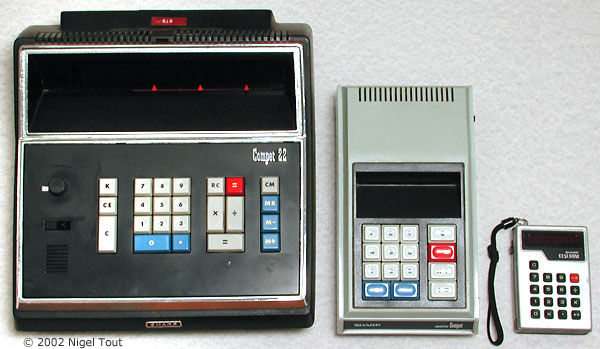
From left to right, Sharp Compet 22 of 1968, Sharp QT-8D of 1969, Sharp EL-801 of 1972.
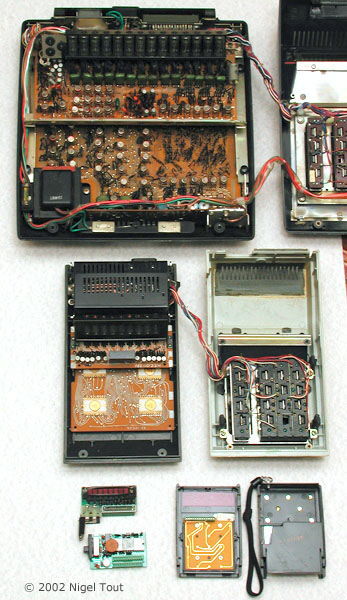
The photographs above and on the left illustrate the size reduction over about 4 years made possible by developments in integrated circuits.
On the left, from top to bottom:
- Sharp Compet 22 of 1968, with many medium-scale integration (MSI) integrated circuits, AC powered.
- Sharp QT-8D of 1969, with four large-scale integration (LSI) integrated circuits, AC powered.
- Sharp EL-801 of 1972, with two CMOS LSI integrated circuits, battery powered.
References:
- "Use of LSI in consumer areas picks up, but problems remain", Electronic Design, January 7, 1971, p34.
- Electronics, March 17, 1969, p204.
- Nations Business, October 1970, pp48-49.
- Curran, Lawrence, "Autonetics arrays its MOS forces", Electronics, April 28, 1969, pp103-105.
- "Autonetics delivering Hayakawa MOS LSI after cold summer", Electronics, September 15, 1969, p47.
- "U.S. firms gird for calculator battle", Electronics, November 23, 1970, pp83-84.
- "Japanese nix high royalties for Nixie tubes", Electronics, June 26, 1967, pp203-204.
Electronic Desk
Calculators
Vintage Calculators
Text & photographs copyright, except where stated otherwise, © Nigel Tout 2000-2026.