
Liquid Crystal Display (LCD) Calculators
Portable or pocket electronic calculators have 2 basic types of displays. One emits light, usually in some color like red, blue, green, or orange. This type of display can be a light emitting diode (LED) or some sort of tube encased display (like a fluorescent tube or Nixie tube). There are a few other light emitting types which we'll discuss in a later article.)
The second type of display is a reflective type of display, usually called "liquid crystal display" or LCD. LCDs were first used for calculators in 1971 and 1972 by Rockwell, Sharp, and Texas Instruments. The benefit was a lower power consumption for the calculator. Unfortunately these early LCD displays did not have the manufacturability or durability expected of a consumer device. Within a year or two, the first LCDs were abandoned.
Research was still being performed and LCD displays were eventually refined enough to use again. At first a yellow filter or "screen" was used to block harmful ultraviolet light. Further LCD refinements made that unnecessary. By approximately 1975 and 1976, LCDs were popping up on a few calculators. By the end of the 70's, LCD displays were seen in 95% of the new calculators.
We are beginning to list LCD models for two main reasons. First, they will help document LCD calculators. In another case (and more importantly to some of us), this list should also help those who DO NOT want LCD calculators and need a reference source in case someone offers an unknown model. In the second case, while a buyer can ask for display information, I have sometimes found sellers who don't understand the concept and give false information (with honest intentions). We will also list the "yellow screen" LCDs, the early Rockwell, Sharp (Calculator-on-Substrate - COS) and TI efforts separately on this page.
We need your help!!!!!
If you have any LCD models, please get in touch with us with the model number and some basic information (like is it a "yellow screen" or just silver/gray color). If you have any date information, please include that also.
(A big thanks to Thomas Brockmeier, Andrew Davie, Larry Gilbert, Bob King, Jeff Lane, Timo Leipalc, Randy Massey, Bob Patton, John Robinson, Pepe Tozzo, and Charles Vesser for their help).
Early LCD models (1972-73)
- Dataking -- LC-800 (Rockwell made)
- Harden -- DT/12 (Rockwell made) same case as Dataking LC-800
- Ibico -- 086 (Rockwell made) same case as Dataking LC-800
- Lloyds -- 40 (Rockwell made) same case as Dataking LC-800
- Lloyds -- 100 (Rockwell made)
- Prismatic -- 500, aka P500 (Rockwell made) same case as Dataking LC-800
- Sears -- M12 (AC powered)
- Sharp -- EL-805 (early COS-LCD)
- Sharp -- EL-805M (early COS-LCD)
- Sharp -- EL-808 (early COS-LCD)
- Sharp -- EL-808 (early COS-LCD)
- Sharp -- EL-8008 (early COS-LCD)
- Sharp -- EL-8009 (early COS-LCD)
- Sharp -- EL-8010 (early COS-LCD)
- Sharp -- EL-8015 (early COS-LCD)
- Sharp -- EL-8110 (early COS-LCD)
- Texas Instruments -- Minimath
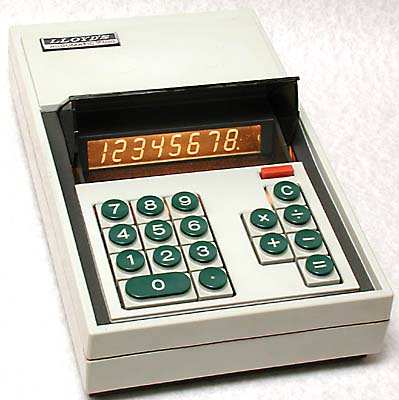
Lloyds Accumatic 100
Manufactured by Rockwell, this hand-held calculator uses a filament lamp to illuminate the display. A flip-up hood helps to give the display good contrast.
This is a featured calculator.
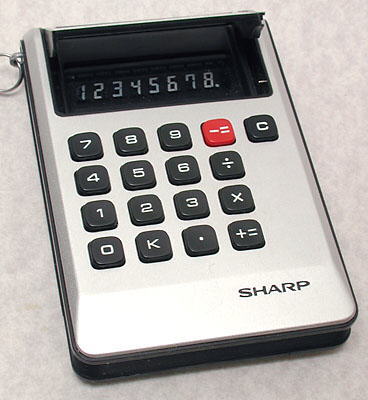
Sharp EL-805
The first Sharp LCD calculator. It uses COS ("Crystal on Substrate") technology where the LCD display was manufactured as an integral part of the glass circuit board.
The flip-up hood has a window to help illuminate the display properly.
Later "early" LCD models (approx. 1974-1980's)
- APF -- 3550A (silver/gray)
- Aurora -- AP-815 (silver/gray)
- Canon -- Card, aka CC-20 (yellow screen)
- Casio -- CP-10 (silver/gray)
- Casio -- FX-2000 (yellow screen)
- Casio -- HL-801 (yellow screen)
- Casio -- HL-807 (yellow screen)
- Casio -- HR-5 (silver/gray)
- Casio -- pocket LCII, aka CL-812 (yellow screen)
- Casio -- LC-78 "Mini Card" (yellow screen), the first credit-card sized calculator.
- Casio -- LC 826 (yellow screen)
- Commodore -- CQ-SWAT (yellow screen)
- Commodore -- LC5K1 (yellow screen)
- Commodore -- LC 925 (yellow screen)
- Hanimex -- LC-640 (silver/gray)
- Lloyds -- E615 (silver/gray)
- Lloyds -- E621-1 (silver/gray)
- Luxury -- LC-310BK (silver/gray)
- Luxury -- LC-320 (silver/gray)
- Luxury -- LC-333 (silver/gray)
- Luxury -- LC-805 (silver/gray)
- MBO -- 2003W (yellow screen)
- MBO -- LC2000 (yellow screen)
- National Semiconductor -- 99 (silver/gray)
- National Semiconductor -- 100A (silver/gray)
- National Semiconductor -- 199 (silver/gray)
- Olympia -- LCD 1600A (yellow screen)
- Panasonic -- JE-8355U (yellow screen)
- Petrous -- Solaris PS-I (silver/gray)
- Privileg -- LC 1081 SR (yellow screen)
- Radio Shack -- EC-225 (yellow screen) -- odd, since there is an EC-225 model that is LED/tube type also.
- Radio Shack -- EC-264 (yellow screen)
- Radio Shack -- EC-265 (silver/gray)
- Royal -- Solar 1 (silver/gray) Solar powered
- Sears -- 711.58440 (silver/gray) Solar powered
- Sharp -- EL-203 (yellow screen)
- Sharp -- EL-206 (yellow screen)
- Sharp -- EL-208 (silver/gray)
- Sharp -- EL-218 (silver/gray)
- Sharp -- EL-220 (silver/gray)
- Sharp -- EL-230 (silver/gray)
- Sharp -- EL-505 (silver/gray)
- Sharp -- EL-515 (silver/gray) Solar powered
- Sharp -- EL-506H (silver/gray)
- Sharp -- EL-5806 (silver/gray)
- Sharp -- EL-8024 (yellow screen)
- Sharp -- EL-8029 (silver/gray)
- Sharp -- EL-8034 (yellow screen)
- Sharp -- EL-8130 (silver/gray)
- Sharp -- EL-8141 (silver/gray)
- Sharp -- EL-8145 (silver/gray)
- Texas Instruments -- TI-1750 (yellow screen)
- Texas Instruments -- TI-1750-II (yellow screen)
- Timex -- Mathmate, aka 90000 (yellow screen)
- Toshiba -- LC-830 (yellow screen)
- Toshiba -- LC-836MN, aka Memo Note 30 (yellow screen)
- Toshiba -- LC-1019N (silver/gray)
- Toshiba -- SLC-8100 (yellow screen)
- Toshiba -- SLC-8300 (yellow screen)
- Unisonic -- LC-12 (silver/gray)
- Unisonic -- LC224 CK (silver/gray)
- Unisonic -- XL-98 (yellow screen)
- Zykkor -- LC-244 (silver/gray)
Copyright 1997, 1998 Guy Ball.
Calculator Articles
Vintage Calculators
Text & photographs copyright, except where stated otherwise, © Nigel Tout 2000-2026.