Sharp PC-1210 & Sharp PC-1211
(Radio Shack/Tandy TRS80 PC-1)
The Sharp PC-1211 and Sharp PC-1210 Pocket Computers, introduced in 1980, are included here to show the culmination of ten years of development of the hand-held calculator. Although by this time there were many programmable pocket calculators, starting with the Hewlett-Packard HP-65 of 1974, thee models here can legitimately be described as a pocket computers since, unlike the programmable calculators, they have a full "QWERTY" keyboard and are programmed in the high-level BASIC computer language.
The Sharp PC-1211 (also sold by Radio Shack/Tandy as the TRS80 PC-1) and Sharp PC-1210 are similar, just differing in the amount of program memory.
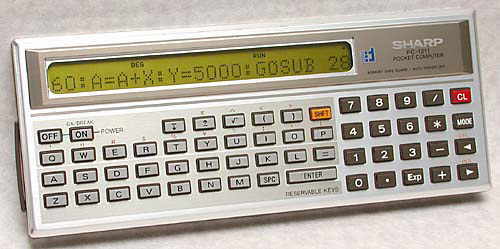
Sharp PC-1211 Pocket Computer, also sold as the RadioShack/Tandy TRS80 PC-1
Distinctive features: First hand-held pocket computer, with the smaller program memory PC-1210 below, programmable in the BASIC language.
Technical details:
Display
- 24-digit alphanumeric dot matrix Liquid Crystal Display, with yellow filter.
In calculator mode it can display in scientific format 10 digits mantissa and 2 digits exponent.
Functions - Calculator and 1424 step BASIC language programmable computer, compared with 400 steps of the PC-1210 below.
26 Fixed memories.
Up to 178 Flexible memories (shared with program memory).
Battery back-up of CMOS memory.
A cassette recorder can be connected using an adapter cradle, allowing programs to be saved to audio cassettes. Also a printer & and cassette adapter was available, see photograph below, thus providing the full needs of a pocket computer.
Power supply - 4x Mercury button cells, giving "approx. 300 hours" use. The power consumption is 0.011 watts.
Semiconductors - CMOS LSI, including:
- CPU 1 - SC43177.
- CPU 2 - SC43178.
Two CPUs (Central Processing Units):
Three TC5514P, 4 K-bit RAM.
Size 175 x 70 x 17 mm (6.9" x 2.75" x 0.7").
Introduced - 1980[1].
Made in Japan.
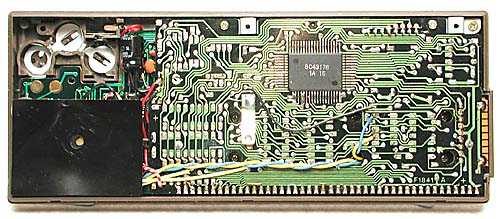
With the rear cover removed showing the "operation" pcb. CPU 2 is the chip in the centre of the board.
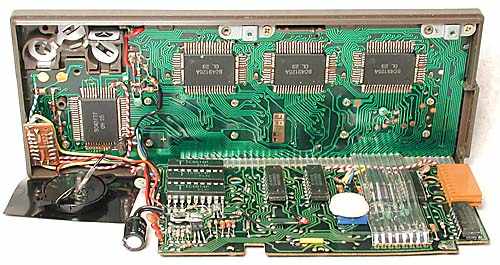
The "operation" pcb has been hinged downwards to show components on its rear, including the three RAM memory chips on the left.
The "keyboard & display" pcb is revealed, which has the CPU 1
chip on its left, and three display chips (with built-in RAM) from top-centre to right.
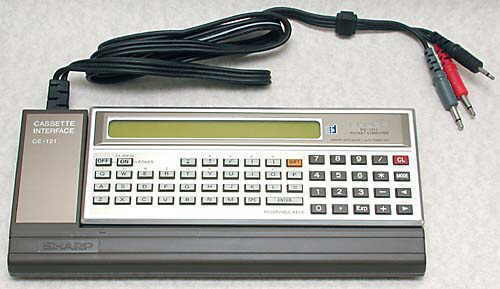
The PC-1211 attached to the CE-121 Cassette Interface unit, which allows programs to be stored on audio cassette tapes and recalled later.
The red plug goes to the cassette recorder "Mic" socket, the grey plug goes to the "Earphone" socket, and the black plug goes to the "Remote" socket.
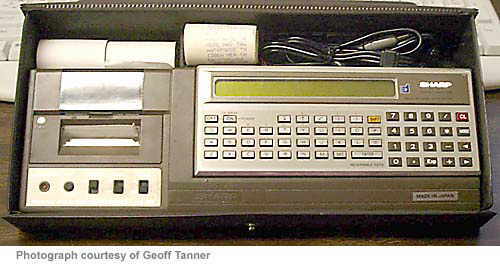
The PC-1211 attached to the CE-122 Printer & Cassette Interface unit and sitting in the de luxe carrying case.
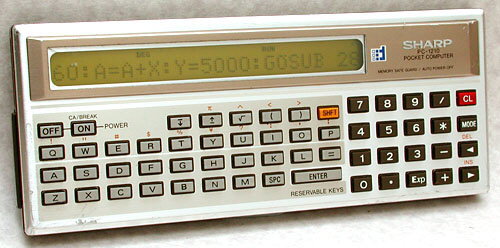
Sharp PC-1210 Pocket Computer
Distinctive features: First hand-held pocket computer, with the larger program memory PC-1211 above, programmable in the BASIC language.
Technical details:
Display
- 24-digit alphanumeric dot matrix Liquid Crystal Display, with yellow filter.
In calculator mode it can display in scientific format 10 digits mantissa and 2 digits exponent.
Functions - Calculator and 400 step BASIC language programmable computer, compared with 1424 steps of the PC-1211 above.
Up to 50 Flexible memories (shared with program memory).
Battery back-up of CMOS memory.
A cassette recorder can be connected using an adapter cradle, allowing programs to be saved to audio cassettes. Also a printer & and cassette adapter was available, see photograph below, thus providing the full needs of a pocket computer.
Power supply - 3x Silver oxide button cells. The power consumption is 0.009 watts.
Semiconductors - CMOS LSI, including:
- CPU 1 - SC43157.
- CPU 2 - SC43158.
Two CPUs (Central Processing Units):
One TC5514P, 4 K-bit RAM.
Size 175 x 70 x 17 mm (6.9" x 2.75" x 0.7").
Introduced - 1980[1].
Made in Japan.
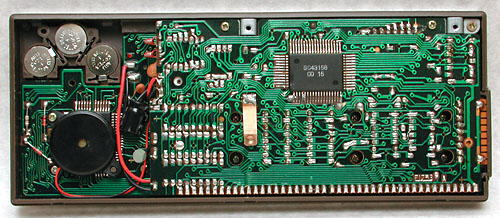
With the rear cover removed showing the "operation" pcb. CPU 2 is the chip in the centre of the board.
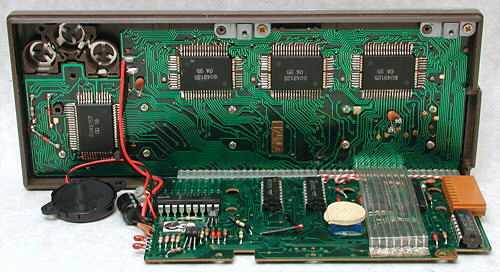
The "operation" pcb has been hinged downwards to show components on its rear, with only a single RAM memory chip on the left, compared with the three RAM memory chips in the PC-1211, at the top of
this page.
The "keyboard & display" pcb is revealed, which has the CPU 1 chip on its left, and three display chips (with built-in RAM) from top-centre to right.
There is information about Sharp pocket computers at http://sharppocketcomputers.com/, including downloadable pdf sales brochure for the PC-1211 and a very interesting Service Manual for it.
LCD screen replacement
The early LCD screens on these models are prone to degrading, typically showing black areas. Robert Baruch has worked out the specification for the screen and has sourced a supply of new replacement screens as described in his YouTube videos. Note that replacing the LCD screen is a process which requires a high degree of skill and it is worthwhile studying these videos to learn of the procedures and some of the problems that may be encountered.
Ten Years of Calculator Progress
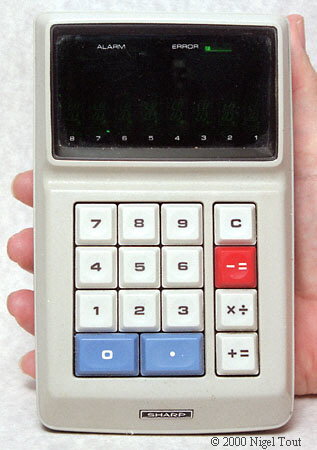
Sharp were one of the pioneers in hand-held calculators in 1970 with the EL-8 and were very successful in the calculator business through the turbulent years of the 1970s. Ten years on from the EL-8 they were still at the forefront of technology with this, one of the first pocket computers.
For comparison, there are details of the Sharp EL-8 below.
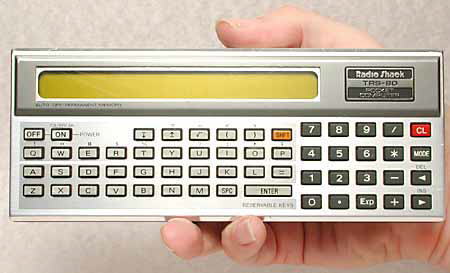
The Sharp PC-1211 pocket computer of 1980, in its Radio Shack / Tandy TRS-80 guise.
 |
|
|
|
|
||
|
Comparison with the Sharp EL-8 hand-held calculator of 1970/1. Functions:
Batteries:
Cost:
|
||||||
 |
||||||
 |
||||||
 |
||||||
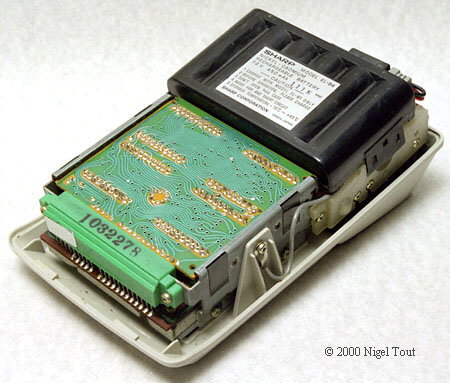
Sharp EL-8 with the back removed showing the rechargeable battery pack containing 6x AA NiCad cells.
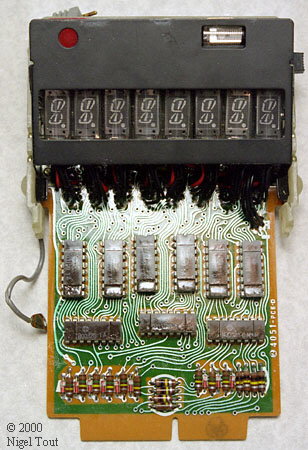
The display board of the Sharp EL-8 with the vacuum fluorescent display tubes and the display driver chips.
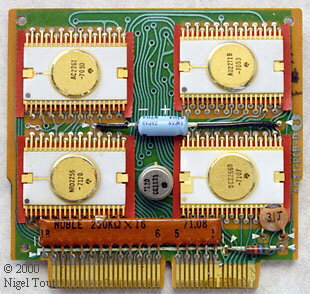
The calculating circuit board of the Sharp EL-8 with the 5 chips then required to give the standard 4 functions.
See the document 'A History of Pocket Computers 1980-2000' by Roland J. Saam for an interesting insight into the development of pocket computers.
Reference:
Hand-held Calculators
Vintage Calculators
Text & photographs copyright, except where stated otherwise, © Nigel Tout 2000-2026.